
Martinsville City Tax Record Fields
Two offices share the work. The Commissioner of the Revenue keeps the real-estate assessments, and the Treasurer bills and collects. Martinsville's sources point to DataScout for ownership, parcel characteristics, assessed values, mapping, and sale statistics. MuniSelfService carries the tax-year bills. The table below routes each question to the office that can answer it.
| Field or record | What it tells you | Where to look |
|---|---|---|
| Assessed value | Value used by the city for local real-estate assessment | Commissioner of the Revenue / DataScout |
| Tax year | The period for the bill inquiry or payment | MuniSelfService; required search field |
| Parcel ID and owner | Identifies the billed property or taxpayer | Treasurer's real-estate module |
| Address | House number and street name for a bill search | MuniSelfService address fields |
| Appeal notice | Review steps and dates for a reassessment cycle | City real-estate assessment page and notice |
Never merge the assessed amount and the tax amount. A value is the base. A bill reflects the rate, the period, and any exemptions or other adjustments. Martinsville's published pages offer no complete exemption inventory. Ask the assessor about a specific parcel or qualification before assuming a flag or reduction applies.
Search a Martinsville Tax Bill
The Treasurer's MuniSelfService Real Estate module accepts a parcel ID, owner name, or address. The tax year is required. The city does not say every field must be populated. A query can take several minutes. Use the year printed on the bill or notice. That way the result reflects the right period.
- Open the real-estate inquiry and select or enter the tax year.
- Search with a parcel ID, owner name, or house number and street name.
- Compare the returned parcel and taxpayer with the assessor record.
- Use the payment option only after confirming the bill period and amount.
The official tax lookup is linked here. Open MuniSelfService Real Estate for the city's field set and live results.
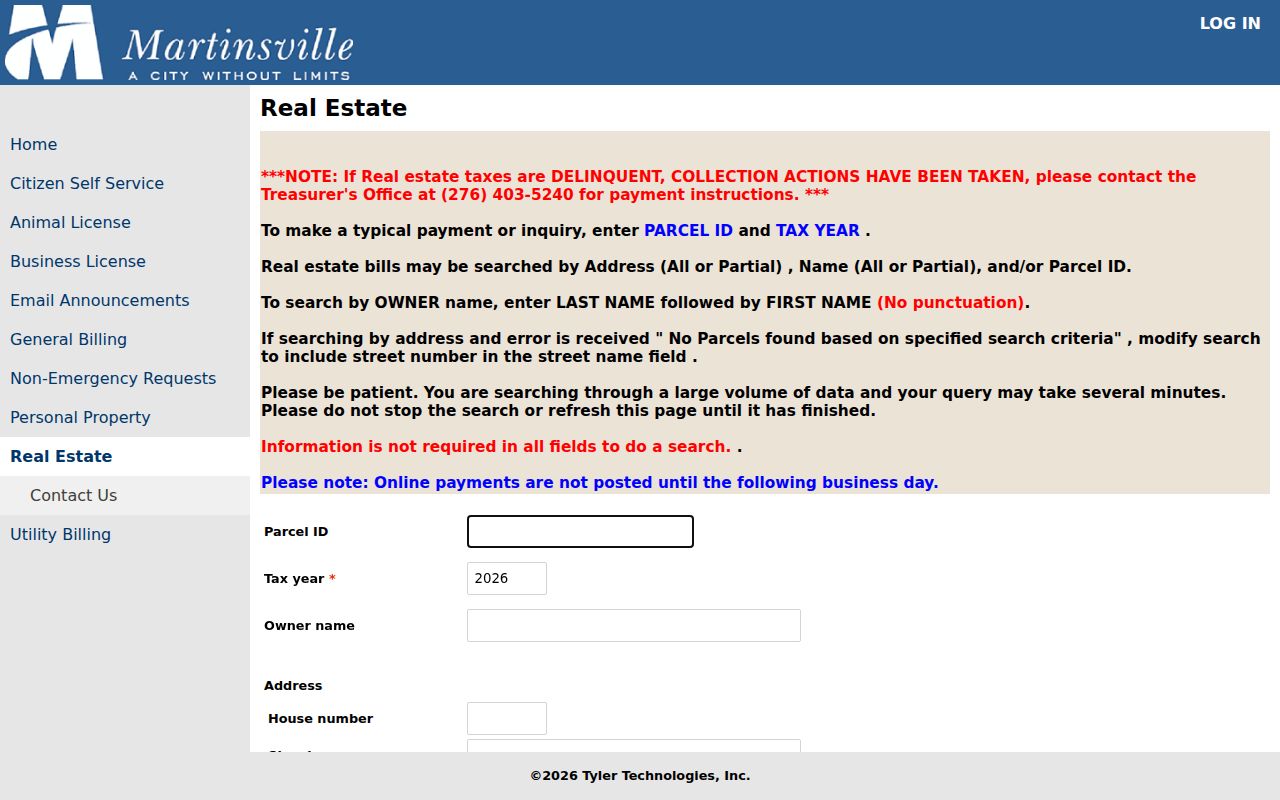
Keep the search year with any result. An account can carry different bills or statuses across tax periods, so the year is part of the answer.
Martinsville Tax Owner Names
The city's bill search gives a formatting rule. Enter the owner's last name first. Then the first name follows, with no punctuation. A business, trust, or estate may sit under an entity label instead of a person's name. If a name search comes back empty, compare the exact spelling on a prior bill or deed and try the parcel ID. Not every matching rule appears in the interface.
Address entry splits the house number from the street name. If the portal returns “No Parcels found based on specified search criteria,” Martinsville advises adding the house number to the street-name field. That is a workaround for this tax module. It does not govern the assessor or the deed index. The city also warns that the online display is not a legal document.
- Tax year
- The bill period selected for inquiry; Martinsville makes this a required field.
- Taxpayer name
- The name associated with a bill search, entered last name first without punctuation.
- Parcel ID
- A parcel reference that can narrow a bill search and connect the result to the assessor.
Martinsville's 2025 Reassessment
Martinsville reassesses real estate every two years. The 2025 work was completed in late February. Notices were due by February 28, and the assessor's review period ran March 3 through March 31. The city described Board of Equalization applications as due April 1, with the Board's work to finish by May 15. Those are the published dates for that cycle, not a future calendar to reuse without checking.
The values were set as of January 1, 2025 and applied from July 1, 2025 through June 30, 2027. The sales study covered January 2023 through December 2024. A biennial roll can drift from a fast-changing market between updates. The city says localities assess at 100 percent of fair market value, but the cycle date still matters when comparing an assessed amount with a later sale.
The official image links to the assessment and review information. Martinsville's reassessment page contains the current city explanation and posted forms.
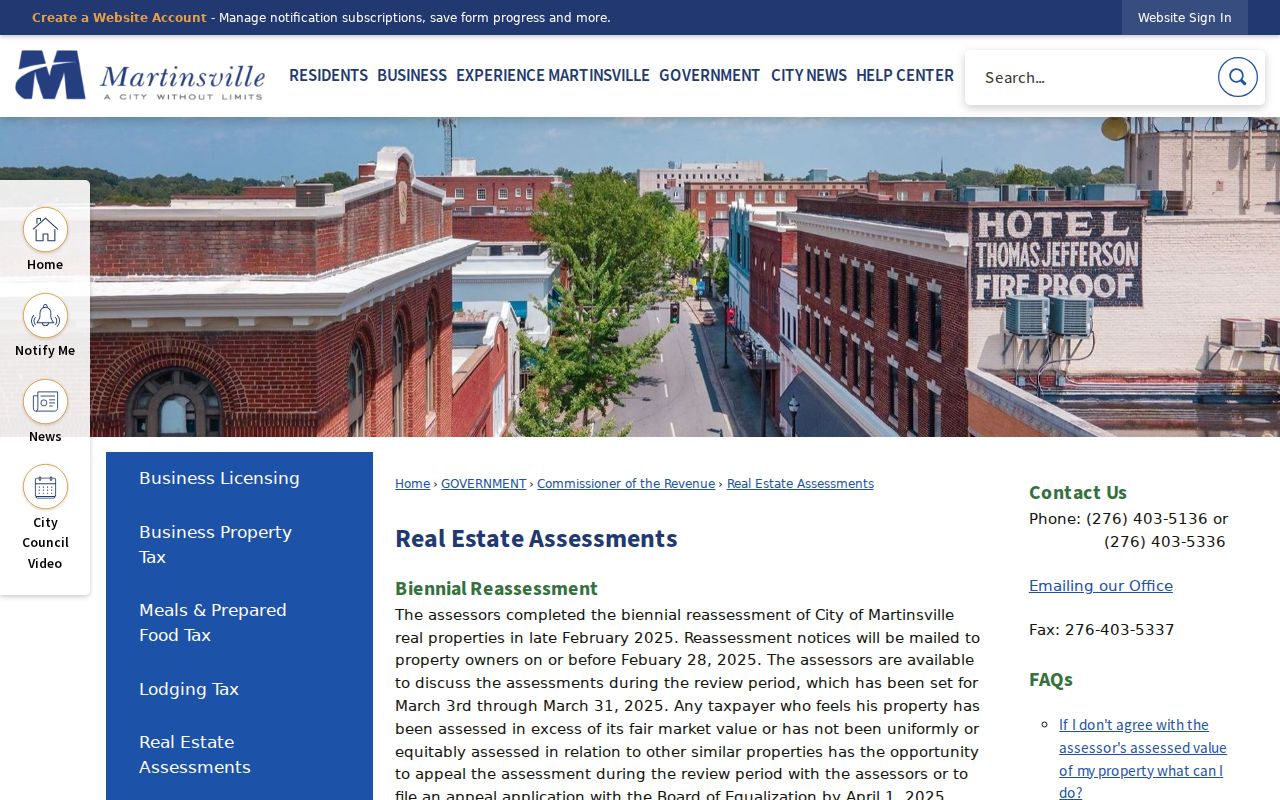
Rely on the notice for this parcel. Use the live city page for any later cycle, since appeal deadlines can shift with each reassessment.
Martinsville Sales Study Window
The 2025 study used sales from January 2023 through December 2024. That two-year window shaped the valuation. It took effect in July 2025. One sale rarely fits every parcel. The city defines an arm's-length sale as a deal between willing, unrelated parties, with reasonable market exposure and typical financing. Each property is judged at its highest and best use. Martinsville uses more than one valuation method. Comparable sales, cost less depreciation, and income all play a part. A sales comparison is one input. It does not guarantee a house should match a nearby closing. Land, improvements, condition, use, timing, and sale terms can all matter, so ask the assessor how the current record relates to the parcel instead of applying a raw average.
Martinsville Value and Tax Rate
The assessed value and the adopted tax rate are separate parts of a Martinsville tax bill. The rate is one piece. The assessment is another. Council sets the rate. The assessment office does not. For fiscal year 2027, the year runs July 1, 2026 through June 30, 2027. City Council adopted a real-estate rate of $0.84 per $100 of assessed value. That rate changes the tax calculation without changing the parcel's underlying assessment.
Exemptions and adjustments can affect what is owed without erasing the assessed value. The city publishes no complete exemption list or application sequence. Ask the Commissioner of the Revenue which program fits and what proof it needs. For the bill total, ask the Treasurer. Keep those questions separate. That way it is easier to see the source of a difference. It may come from valuation, the rate, a credit, or the bill period.
Review a Martinsville Assessment
Martinsville's 2025 reassessment followed a two-step path. An owner first requested an assessor review and could then apply to the Board of Equalization. The posted calendar set the review window at March 3 through March 31. April 1 was the Board application due date for that cycle. Board work was scheduled to finish by May 15. The assessment page carries the city's review and application materials. A later cycle may use different dates.
Compare the notice against the parcel record. Gather evidence of value as of the assessment date. The city explains that a sale comparison should account for the parties, exposure, financing, property condition, and highest and best use. Contact the assessor about the review route. Then confirm the current Board deadline on the notice or the city page, and never rely on a prior cycle's date.
Check the cycle before filing. The documented April 1 Board deadline applies to the 2025 process only. Confirm the date printed on the current Martinsville City notice.
Martinsville Delinquent Tax Bills
Delinquent Martinsville tax bills involving collection action go through the Treasurer at 276-403-5240. Use the tax year and the parcel or owner details in any payment inquiry. The city posts no separate tax-sale calendar. Nor does it list an auction inventory. A delinquent bill is not itself proof that a foreclosure or sale has been filed. That history takes a court or land-record search.
Online payments post the following business day. The city's general service page lists the fees: 2.55 percent for card convenience with a $2 minimum, and $0.50 for a checking-account payment. The processor collects those charges rather than the city. Verify the method and amount before submitting. That matters most near a deadline or collection action.
The Treasurer's page handles payment instructions. The Circuit Court Clerk handles a recorded deed or lien. Keep the bill inquiry separate from any recorded instrument and the case file.
Martinsville Tax Record Limits
A tax bill shows the year and the balance. That is its limit. It is not a legal document and does not establish clear title. The assessor's value is a tax-administration figure, not an appraisal for a sale. The city map can locate a parcel. It cannot settle a boundary. If the bill name differs from the latest deed, keep both records and ask the relevant office which system needs review.
For a precise request, identify the parcel, tax year, and record sought. Virginia FOIA permits actual cost charges and a deposit when an estimate exceeds $200. The public body need not create a new statement. Ask for a cost estimate before requesting a large history. Assessment questions go to the assessor. Payment status goes to the Treasurer. For title, use the clerk's recorded land instruments.