
Martinsville City Property Value Types
Know what a number measures before comparing it. Martinsville's assessor portal describes assessed values and sale statistics. The reassessment page explains fair market value. Its study process is laid out there as well, while a deed may show consideration for a recorded transfer even though no stable public field or sample card displays that amount. Write the source and date beside every value.
| Value type | What it means | Where it is recorded |
|---|---|---|
| Assessed value | Local value used in the real-estate assessment roll | Commissioner of the Revenue / DataScout |
| Fair market value | Value estimate under the city's stated market standard and methods | Reassessment explanation and valuation work |
| Sale price | Amount tied to a particular transaction, with terms that matter | Recorded deed or sale data when shown |
Why does a seller's price differ from the assessment? Sale date, condition, financing, and market exposure all vary. A valuation number cannot capture every physical or legal feature of a property, so treat it as one record among many.
Martinsville Assessed Value
Martinsville's chief assessor is the Commissioner of the Revenue. The city says its DataScout database holds ownership, property characteristics, assessed values, enhanced GIS layers, imagery, and sale statistics. Field labels vary. A live result may or may not display land value, improvement value, exemptions, or a last-sale field. Check the parcel card before assuming what it includes.
To find the assessed figure, pull the parcel in the city property system and note the tax year or assessment cycle tied to the result. A vendor table lists Martinsville as updated nightly. That schedule refers to data refresh, though, not recalculation. The assessor's valuation cycle runs every two years. Keep the search date and effective period with the figure when you compare it to a later sale.
Martinsville Fair Market Value
Localities assess real estate at 100 percent of fair market value, according to the city. An arm's-length sale means willing, unrelated parties with reasonable market exposure and typical financing. Valuation also weighs highest and best use. The result is a public assessment under a stated method. It is not a private appraisal for a particular buyer or seller.
Martinsville names three approaches: comparable sales, cost less depreciation, and income. Not every method suits every property. The city's assessment page gives the framework. No individual parcel worksheet or method weighting is published. Ask the assessor about the specific record. Reverse-engineering a calculation from the total rarely works.
Martinsville Biennial Value Cycle
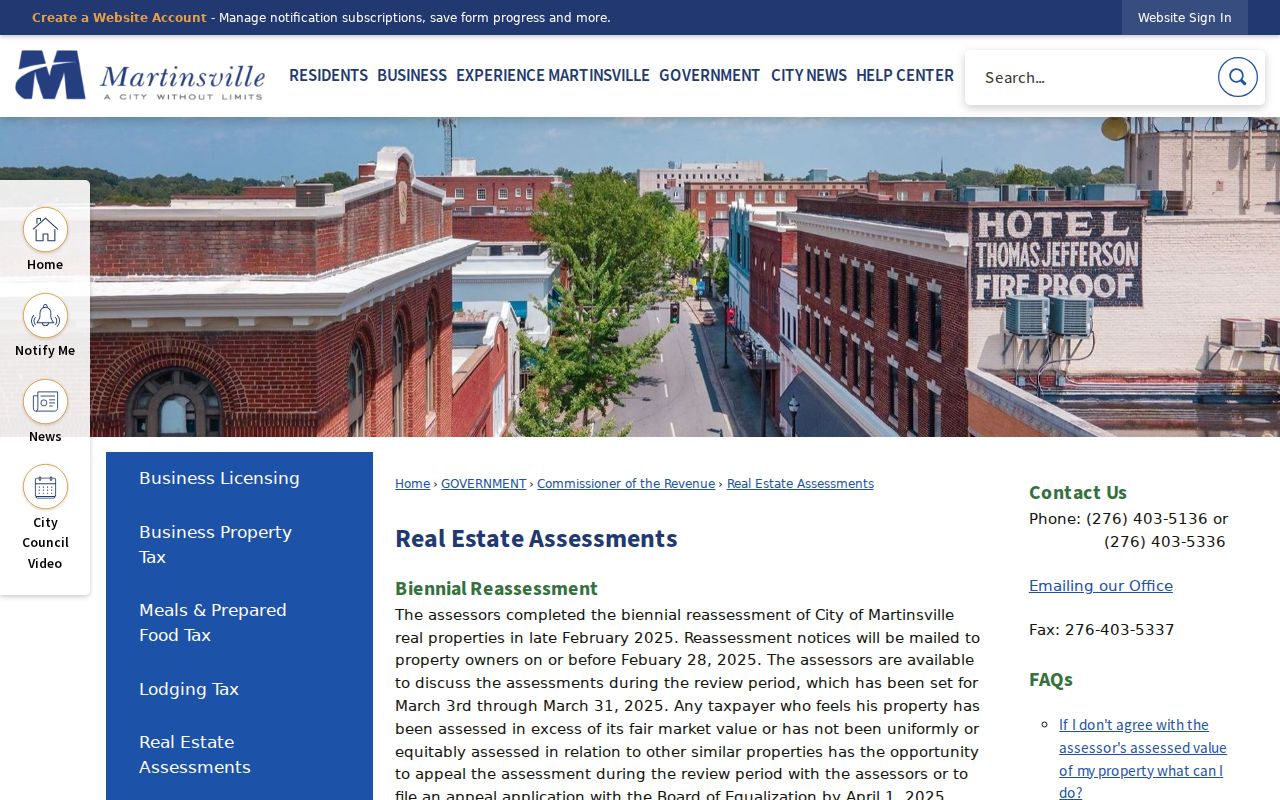
Martinsville's 2025 reassessment used sales from January 2023 through December 2024. Values were set as of January 1, 2025 and took effect July 1, 2025 through June 30, 2027. Because the city reassesses every two years, market movement after the sales window can create a gap between an assessed amount and a later offer or sale. This is ratio drift over time, not necessarily a data error.
The assessment page provides the local dates and explains the study. Read the city's reassessment information before comparing a value from another cycle.
Read the effective dates, not just the amount. A figure applies only to the period the city states.
Martinsville Sale Study Context
The 2025 study used a two-year sales window. A nearby sale is still not an automatic match. The city spells out what makes a transaction useful: willing and unrelated parties, reasonable exposure, and typical financing. Age, upkeep, use, land, and improvements can all change the comparison. A distressed or unusual sale may not match the market standard the city describes.
DataScout advertises a sale-statistics tool. Its filters and method are not published. Use it to inspect sales context, not to replace the assessor's explanation or an appraisal. Note the sale date and source. Compare the amount with the current assessment from there.
Martinsville Recorded Sale Price
A deed and an assessment answer different questions. The recorded deed proves an instrument was filed and can name parties and a legal description. It may carry consideration. The online index publishes no sample deed result showing how a price displays. The assessor page separately advertises sale statistics. Treat these records as distinct.
For a recent sale, confirm the deed through COVERS/SRA and check its recorded date against the assessor's effective value period. The clerk's index covers current deeds from July 1, 1971, with separate legacy data from 1942 through 2005. Image access can require authorization. A sale price is a fact about one transaction, while an assessed value is a tax figure built on a broader cycle.
Martinsville Value and Rate
A tax rate moves the bill, not the value. That distinction matters in Martinsville. City Council adopted $0.84 per $100 of assessed value for FY2027, the fiscal year running from July 1, 2026 through June 30, 2027. Setting that rate is Council's job. Assessing the property belongs to the Commissioner of the Revenue. Keeping the two parts separate explains why a tax total can shift even when a parcel's value record stays the same.
Exemptions and other adjustments can also change taxable liability. No complete local exemption list appears in city materials, and which programs fit a parcel varies. A bill that differs from a simple rate calculation has not erased the assessed value. Ask the assessor about the value. Ask the Treasurer about the bill. Detailed payment and appeal steps sit with the tax-record information.
Martinsville Zoning and Value
Two similar parcels can carry different values for plain reasons. Martinsville's zoning ordinance dates to 1964. It sorts land into ten broad categories. Residential labels include R-C, R-N, R-E, and R-T. Community Development also publishes historic-district design guidance, enterprise-zone maps, an Uptown physical-improvements plan, and a 2022 citywide residential-property conditions assessment.
None of that settles what one parcel is worth. Zoning classification proves neither ownership nor a survey. A historic designation does not set a sale price by itself. Rely on the assessor record for the official assessed value and on the planning office for land-use questions. The city's zoning page identifies the ordinance and map resources through Martinsville Planning and Zoning.
Treat the zoning map as context only. Ask staff to confirm a parcel's current district and any case-specific status.
What Martinsville Value Cannot Tell
An assessed amount is not a promise of price. It is not an appraisal either. The biennial cycle can lag a fast-moving market. A property record may also omit factors behind a valuation. Each source has a narrow job: a sale statistic describes one transaction, a map locates a parcel, and a deed records an instrument.
For an assessment question, use the city's review process and current notice. For a tax balance, pick the bill year in MuniSelfService. For a transfer, check the deed. For a boundary, review a plat. Together, these sources can inform a value question without turning one figure into a promise of what a property is worth today.
Assessed value is for local tax administration. It is not an appraisal and does not state what a Martinsville City property will sell for.